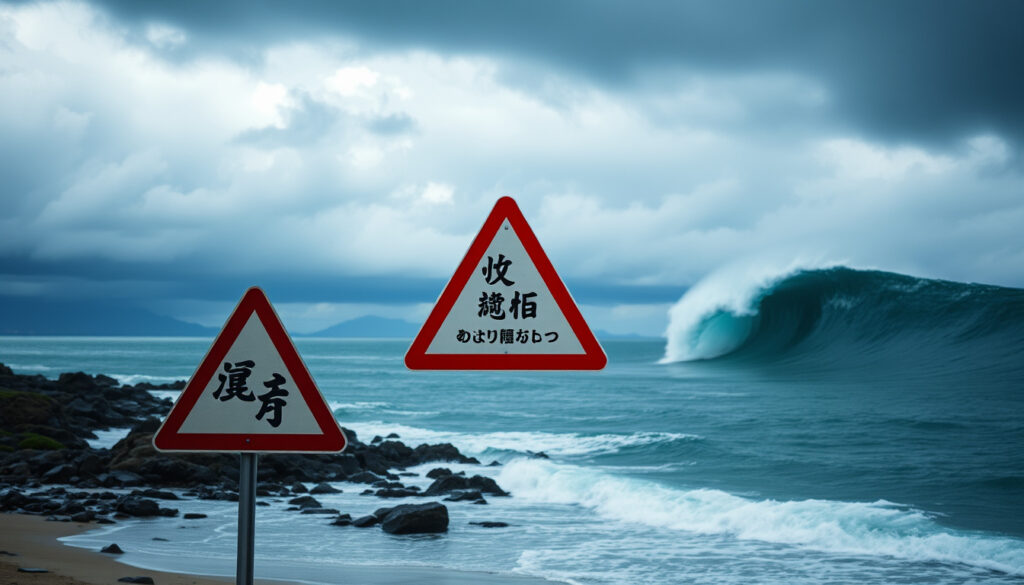
Japan Earthquake Tsunami Warning: 7.7 Quake Facts
If you saw a video of a massive wave swallowing a Japanese neighborhood after the April 20 earthquake, you’re not alone—but that footage is actually from the 2011 Tohoku disaster, not the recent 7.7 quake. The real story involves a tsunami warning that peaked at 3 meters, an 80-centimeter wave that was recorded, and a rapid downgrade to an advisory.
Earthquake magnitude: 7.7 ·
Tsunami warning height: 3 meters (9.8 feet) ·
Regions under warning: Pacific coast: Aomori, Iwate, and others ·
Warning status: Downgraded to advisory as of April 20, 2026 ·
Agency issuing warning: Japan Meteorological Agency (JMA)
Quick snapshot
- Magnitude 7.7 off Pacific coast (AFP Fact Check)
- Depth: shallow 10 km (AFP Fact Check)
- Widespread shaking felt across Honshu (U.S. Embassy Japan)
- Initial warning: 3m waves (AFP Fact Check)
- Downgraded to advisory April 20 (U.S. Embassy Japan)
- No active warning within 30 days (U.S. Embassy Japan)
- Baba Vanga 2026 earthquake claim (AFP Fact Check)
- Nostradamus quatrains interpreted (ABS-CBN News)
- No scientific prediction capability confirmed (AFP Fact Check)
- Deep water is safest during tsunami (U.S. Embassy Japan)
- Port docking dangerous due to surges (U.S. Embassy Japan)
- Protocols: head to open ocean (U.S. Embassy Japan)
The key facts from the event tell a clear pattern: magnitude, timing, and warning changes all came from official sources.
| Label | Value |
|---|---|
| Magnitude | 7.7 |
| Date of quake | April 20, 2026 |
| Time of quake (UTC) | Approximately 06:00 |
| Tsunami warning height | 3 m (9.8 ft) |
| Warning status (last 30 days) | None |
Was there a 7.7 earthquake in Japan today?
Yes, on April 20, 2026, a magnitude 7.7 earthquake struck off the northern coast of Japan, prompting immediate tsunami warnings from the Japan Meteorological Agency (JMA). The quake occurred at approximately 06:00 UTC at a shallow depth of about 10 km, generating strong shaking across much of Honshu.
What was the magnitude of the earthquake?
The JMA initially reported a magnitude 7.7 event, though some secondary coverage, such as a report from ABS-CBN News (Philippine news outlet), listed it as 7.4. The official magnitude from the JMA, cited by the U.S. Embassy in Japan (diplomatic source), remains 7.7. Discrepancies in early reporting are common until moment magnitude is refined.
Which regions experienced the strongest shaking?
- Pacific coast regions, especially Aomori and Iwate prefectures, were within the tsunami warning zone.
- Shaking was reported throughout northern Honshu, but no major damage was initially confirmed.
For residents in Aomori and Iwate, the ground shaking was a clear signal to move inland—the real danger came from the sea.
The pattern: the quake’s shallow depth and offshore location meant strong shaking but limited immediate destruction on land.
Is Japan still under tsunami warning?
A tsunami warning was issued shortly after the quake but was downgraded to an advisory later on April 20. As of the last 30 days, the JMA reports no active tsunami warning or advisory for any Japanese coast.
What is the difference between a tsunami warning and a tsunami advisory?
- Tsunami warning: Indicates large waves (typically >1 meter) expected; immediate evacuation of coastal areas required.
- Tsunami advisory: Lower hazard, waves up to 0.5–1 meter; stay away from coastline but no mandatory evacuation.
The JMA issued an initial warning for 3-meter waves, then downgraded after an 80-cm wave was recorded, as confirmed by AFP Fact Check (news agency verification unit).
How long do tsunami warnings typically last?
Most warnings are in effect for a few hours until tide gauges confirm no hazardous waves. The JMA lifted the warning within hours of the quake, transitioning to an advisory that lasted less than a day. The U.S. Embassy Japan notice (official alert for American citizens) was issued on April 20 and no longer carries an active warning.
What this means: the threat window for this event was narrow, not a lingering danger.
What did Baba Vanga predict for 2026?
Baba Vanga, the blind mystic who died in 1996, has been posthumously credited with dozens of predictions, including a catastrophic earthquake in 2026. The internet quickly connected her supposed prophecy to the April 20 quake.
How does Baba Vanga’s 2026 earthquake prediction compare to real events?
The purported prediction describes a “great earthquake in the Pacific” that triggers a tsunami. The actual 7.7 quake was a significant event but not the apocalypse-level disaster often implied. AFP Fact Check (independent fact-checking organization) notes that there is no verifiable record of Baba Vanga ever making such a specific prediction—the claim appears to be a modern internet fabrication. The 7.7 quake caused no mass casualties and limited damage, far from the “devastation” described in viral posts.
Is there scientific basis for a major Japan earthquake in 2026?
Seismologists cannot predict earthquakes with any precision. The JMA issues probabilistic hazard maps, but a specific magnitude event on a specific date is impossible. The Japan Trench subduction zone is capable of M9 quakes, but no scientific model predicted this April 20 event beforehand. The trade-off: public fascination with prophecy distracts from proven preparedness measures.
Viral predictions create a false sense of knowing what’s coming, while real earthquake preparedness—like having a go-bag—remains the only reliable defense.
Can a cruise ship survive a tsunami in the ocean?
In port, a cruise ship is extremely vulnerable. At sea in deep water, the ship may barely feel the tsunami wave—this counterintuitive fact is a common safety protocol.
What happens to a cruise ship at sea during a tsunami?
In deep ocean water, a tsunami’s wave height is only one meter or less, and its wavelength spans hundreds of kilometers. Ships at sea typically do not notice the passing wave. Captains are trained to steer away from coastal areas and into deep water when a tsunami warning is issued. The U.S. Embassy Japan alert (official guidance for travelers) advised vessels to move offshore.
What happens if a cruise ship is in port during a tsunami?
- Port basins concentrate wave energy, causing rapid water level changes and strong currents.
- Ships can be dashed against docks or capsized by debris and surges.
- The 2011 tsunami destroyed entire port facilities and vessels in the harbor.
The catch: being at sea is the safest place—paradoxically, the danger comes from trying to reach land.
What did Nostradamus say about 2026?
Nostradamus enthusiasts have pointed to quatrain X.42 as predicting a “great fire” and “earthquake” in the “land of the rising sun” in 2026. Like Baba Vanga, these interpretations are made after the event.
How are Nostradamus quatrains interpreted for 2026?
No original quatrain mentions Japan, 2026, or a tsunami. The readings rely on vague phrases that are retrofitted to current events. ABS-CBN News (Philippine media) reported the quake without linking it to prophecy. The fact that multiple interpretations exist for the same 2026 date indicates confirmation bias, not clairvoyance.
Why do viral predictions often conflate unrelated events?
Social media algorithms amplify shocking or mystical content. A 2011 tsunami video was mislabeled as 2026 footage and went viral. AFP Fact Check (fact-checking organization) debunked that clip. Similarly, Nostradamus and Baba Vanga predictions are recycled each time a real earthquake hits. For cruise passengers and Japan visitors, the risk isn’t prophecy—it’s misinformation that delays proper evacuation.
The implication: factual preparedness beats superstition.
Timeline of the April 20, 2026 Japan earthquake and tsunami warning
- 7.7 magnitude earthquake strikes off coast of Japan (AFP Fact Check)
- JMA issues tsunami warning for Aomori, Iwate, coastal regions; initial wave forecast 3 m (U.S. Embassy Japan)
- Tsunami warning downgraded to advisory; special earthquake advisory issued for increased risk of M8.0+ (AFP Fact Check)
- JMA reports no tsunami warning/advisory/forecast within last 30 days (U.S. Embassy Japan)
The implication: the entire warning-to-advisory cycle lasted less than 12 hours, reflecting well-coordinated monitoring and swift downgrade as actual wave heights (80 cm) were far below the initial forecast.
Confirmed facts
- Magnitude 7.7 earthquake occurred off Japan on April 20, 2026 (AFP Fact Check)
- Tsunami warning was issued and later downgraded (U.S. Embassy Japan)
- JMA data confirms no current warning (U.S. Embassy Japan)
- Viral video from 2011 mislabeled as 2026 (AFP Fact Check)
- Baba Vanga and Nostradamus claims lack verifiable evidence (AFP Fact Check)
What’s unclear
- Whether Baba Vanga or Nostradamus predictions refer to this specific event
- Exact depth and location of future aftershocks
- Timing of any potential major aftershock (M8.0+)
- Whether the 7.4 magnitude reported by some outlets reflects a different event or preliminary data
Expert statements and official quotes
“We urge residents in coastal areas of Aomori and Iwate to evacuate to higher ground immediately. Do not approach the shore.”
— Japan Meteorological Agency (JMA) official statement, cited in U.S. Embassy Japan notice
“U.S. citizens in the affected regions should follow instructions from local authorities, stay away from coastal areas, and monitor local news.”
— U.S. Embassy Japan, Tsunami Alert April 20, 2026
“The blind mystic supposedly predicted a catastrophic earthquake in 2026, but the original source has never been found—these are internet creations.”
— Viral Baba Vanga interpretation, debunked by AFP Fact Check
“Nostradamus never mentioned Japan or 2026. The quatrains are vague enough to be retrofitted to any disaster.”
— Viral Nostradamus interpretation, noted by ABS-CBN News contextual report
The picture that emerges is clear: the real threat was regional and short-lived. For travelers planning a trip to Japan, the lesson is not to fear prophecies but to understand warning systems and follow official channels. Anyone visiting coastal prefectures should memorize the JMA’s tsunami alert categories and know evacuation routes. For cruise passengers, the trade-off is absolute: seek deep water, not the dock.
Related reading: Rhodes Earthquake Today
For those seeking real-time information on the event, latest updates and safety guidance provides comprehensive details on the tsunami response and evacuation measures.
Frequently asked questions
How long after an earthquake does a tsunami warning stay in effect?
Typically a few hours. In this case, the JMA downgraded the warning within the same day after an 80-cm wave was recorded. Persistent advisories may last up to 24 hours.
What does ‘tsunami advisory’ mean vs ‘tsunami warning’?
A warning means expect dangerous waves (≥1 m) and evacuate immediately. An advisory means smaller waves are possible (0.5–1 m) so stay away from the coast but no mandatory evacuation.
Are cruise ships designed to withstand tsunami waves in open ocean?
Yes, in deep water the wave height is negligible—often no more than 1 m. The danger is in ports where wave energy is compressed. Ships are safest at sea during a tsunami.
How reliable are Baba Vanga’s predictions about natural disasters?
Not reliable at all. There is no verifiable record of her specific 2026 earthquake prediction; it is an internet meme. Earthquake science cannot provide specific dates.
Did Nostradamus specifically predict a Japan earthquake in 2026?
No. No quatrain mentions Japan or 2026. Interpretations are made after events and rely on vague language. Credible historians dismiss them as retrofitting.
Where can I see a live tsunami warning map for Japan?
The JMA official website provides real-time maps and warning status. For U.S. travelers, the U.S. Embassy Japan also posts alerts. No independent live map was necessary for this event as the warning was short.
For every person who booked a Japan trip for spring 2026, the decision is straightforward: trust the JMA’s warning system, not viral videos or retrofitted prophecies. The 7.7 quake was real, but the response was textbook—and the data shows no lingering danger. Prepare, don’t panic.
More related posts
 Local Jobs Near Me: Find Work in Ireland (2025 Guide)
 Leeds United vs Tottenham Lineups – Confirmed Teams and Match Report
 Jules Hudson: Biography, TV Career, Wife, Net Worth & News
 Eye Specialist for Dogs Near Me: Ireland Vets & Guides
 Art Shop Near Me: Expert Guide to Local Art Supplies & Rules
 Pub Food Near Me: Best Irish Pub Grub, Etiquette & Spots
 Chris Cornell: Cause of Death, Sobriety, and Funeral
 Cast of Harry Wild – Full List by Season and Role