What Do Piles Look Like – Symptoms, Types and Treatments
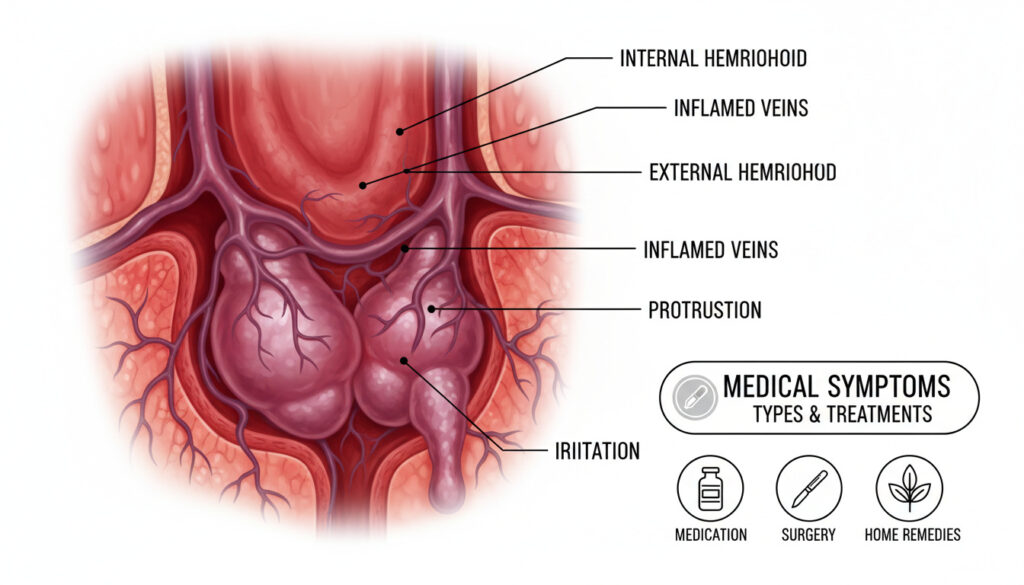
Piles, clinically termed haemorrhoids, present as swollen vascular formations within the anal canal or around its external opening. These engorged veins manifest visually as distinct lumps whose characteristics vary significantly based on anatomical location and physiological status.
The appearance ranges from soft, moist, pinkish protrusions to hard, discolored masses, depending on whether the condition manifests internally, externally, or as thrombosed clots. Visual identification requires understanding these morphological differences, particularly when distinguishing between benign vascular swellings and pathologies requiring urgent medical assessment.
Accurate recognition of these visual markers enables patients to seek appropriate care, whether through conservative home management or professional medical intervention for severe presentations.
What Do Piles (Haemorrhoids) Look Like?
Visual Appearance
Lumps emerging inside or surrounding the anus, displaying colors from pink and red to dark blue or purple depending on type and severity.
Anatomical Types
Three primary classifications exist: internal formations within the rectum, external swellings under perianal skin, and thrombosed external piles containing blood clots.
Common Symptoms
Bright red bleeding during defecation, persistent anal itching, mucus discharge, and varying degrees of pain or tenderness during movement.
Self-Resolution Timeline
Mild vascular swellings frequently resolve within days to weeks through conservative measures, though thrombosed variants require extended healing periods.
Key Visual Characteristics
- Internal piles remain invisible until prolapsed, appearing as soft, pinkish, moist protrusions that may spontaneously retract
- External piles present as skin-colored or pink soft bumps, often resembling pea-sized to grape-sized formations
- Thrombosed external piles form hard, bulb-like lumps displaying dark blue, purple, or black coloration, or grey/dark brown on darker skin tones
- Non-thrombosed external haemorrhoids resemble rubbery skin tags without acute discoloration
- Prolapsed internal tissue may require manual repositioning if extrusion persists
- Clinical images typically reveal bruised swellings below the dentate line or moist pink internal protrusions
| Type | Location | Appearance | Key Symptoms |
|---|---|---|---|
| Internal | Inside rectum | Invisible unless prolapsed; soft, pinkish or reddish moist lumps | Painless bright red bleeding, mucus-related itching |
| External | Under anal skin | Skin-colored or pink soft lumps, pea to grape size | Pain, itching, bleeding, tenderness during movement |
| Thrombosed | External with blood clot | Hard, blue, purple, black (or grey/dark brown on dark skin), swollen | Severe acute pain, significant swelling |
Medical imaging and clinical photographs typically depict these variations with precision, showing the distinct coloration differences between vascular congestion and thrombotic events. Cleveland Clinic documentation confirms that internal formations appear pink and moist when prolapsed, while Healthline’s anatomical guides detail the external presentation as soft tissue colored similarly to surrounding perianal skin.
What Causes Piles?
The pathophysiology mirrors that of varicose veins, arising from increased pressure within the rectal and anal venous plexus. This pressure compromises vascular return, causing dilation and tissue engorgement. Mayo Clinic research identifies chronic straining during bowel movements, prolonged sitting on toilet facilities, and persistent constipation or diarrhoea as primary mechanical factors.
Additional risk factors include heavy lifting activities, obesity, and low-fibre dietary patterns that increase intra-abdominal pressure. Epidemiological data from WebMD indicates that approximately fifty percent of adults experience symptomatic presentations by age fifty, underscoring the condition’s prevalence across demographic groups.
Causes of Piles in Females
Pregnancy introduces unique physiological pressures that elevate risk specifically in females. The growing uterus exerts downward force on pelvic veins, while hormonal changes promote vascular relaxation and congestion. These gestational factors often resolve postpartum, though they represent a distinct female-specific etiology requiring targeted preventive measures during maternity.
Chronic constipation and prolonged toilet sitting generate excessive venous pressure in the rectal region. Pregnancy compounds this through additional downward force on pelvic circulation, explaining the elevated incidence observed in gestational populations.
What Is Piles?
Piles constitute dilated vascular structures resulting from swollen veins in the lower rectum and anus. The condition represents a benign vascular phenomenon rather than neoplastic growth or infectious process. These blood vessel enlargements develop when sustained pressure overwhelms the venous valve system, causing pooling and tissue expansion.
The classification system delineates between internal piles situated above the dentate line within the rectal mucosa, and external piles located below this boundary under perianal skin. Thrombosed external piles represent a complication wherein blood clots form within the external vascular structure, creating acute symptomatic presentations distinct from uncomplicated external formations.
How Are Piles Treated?
Management protocols progress from conservative home interventions to medical procedures based on severity and persistence. Most uncomplicated cases respond to dietary modification and topical measures, while prolapsed or thrombosed formations may require clinical intervention.
Treatment of Piles in Females
Pregnancy-related piles typically resolve spontaneously following delivery as pelvic pressure normalises. Management during gestation focuses on preventive measures including fibre supplementation and hydration rather than invasive procedures. No female-specific pharmacological interventions exist beyond standard conservative care adjusted for obstetric safety.
High-fibre diets, adequate hydration, and warm sitz baths constitute primary therapeutic approaches. Medical News Today guidelines confirm that over-the-counter creams provide temporary symptomatic relief for itching and swelling, though these topical agents do not cure underlying vascular dilation.
Medical interventions include rubber band ligation for persistent internal piles, sclerotherapy injections, and surgical excision for severe prolapsed cases. Thrombosed external piles occasionally require surgical clot removal during acute phases, though many resolve through natural absorption processes.
Are Piles Dangerous and Do They Go Away?
Mild presentations typically demonstrate spontaneous resolution within days to weeks when managed through conservative measures. Thrombosed external piles require extended timelines as the body absorbs the clot, occasionally leaving residual skin tags following resolution. Clinical observations document this healing trajectory across patient populations.
Comparative studies from the Anal Cancer Foundation indicate that bleeding and pain symptoms may mimic anal malignancy. Persistent symptoms exceeding one week, heavy bleeding, or prolapsed tissue require professional evaluation to exclude serious pathology including neoplastic conditions.
While not generally dangerous, rare complications include secondary infection or anaemia from chronic bleeding. Medical consultation becomes essential for symptoms persisting beyond seven days, significant blood loss, or when pain interferes with daily function.
How Do Piles Develop Over Time?
The clinical course follows predictable patterns from vascular congestion through resolution or complication. Understanding this progression helps patients anticipate symptom evolution and appropriate intervention timing.
- Vascular congestion develops from sustained pressure on rectal veins
- Soft tissue lumps form internally or externally without acute discoloration
- Thrombosis may occur in external formations, creating hard, discolored masses with severe pain
- Conservative care implementation reduces swelling and promotes clot absorption
- Resolution occurs through natural healing or medical intervention
- Residual skin tags may remain following thrombosed pile resolution
Piles Facts vs Myths
Established Facts
- Swollen veins cause the condition, not infection
- Dietary fibre and hydration prevent occurrence
- Most cases resolve without surgical intervention
- Thrombosed piles cause severe acute pain
- External and internal types differ in pain characteristics
Uncertain Without Examination
- Exact severity grading without physical assessment
- Specific healing duration for individual cases
- Whether topical creams accelerate healing beyond symptom relief
- Distinction from rectal cancer without biopsy
Understanding Piles in Context
These vascular formations function similarly to varicose veins in the lower extremities, resulting from circulatory pressure rather than infectious or malignant processes. The condition affects all demographic groups regardless of age or gender, though physiological states such as pregnancy and chronic straining increase susceptibility. Pictures of Inflammatory Breast Cancer in Early Stages – Symptoms Across Skin Tones demonstrate how visual health markers vary by skin pigmentation, a consideration relevant when identifying thrombosed pile coloration on diverse skin types.
The ubiquity of the condition—affecting nearly half the adult population by middle age—positions it as a routine medical concern rather than an exceptional pathological event. This prevalence underscores the importance of public understanding regarding visual identification and appropriate self-care protocols.
Expert Sources
Medical authorities provide consistent visual descriptors across healthcare systems, enabling reliable patient education.
“Lumps inside and around your bottom”
NHS Guidance
“Blue, black or purple if thrombosed”
Cleveland Clinic
“Size of pea to grape, pink”
Clinical Dermatology References
What to Do Next
Patients observing anal lumps should assess duration, pain levels, and bleeding characteristics. Conservative management through dietary fibre and sitz baths provides appropriate first-line intervention for mild cases. Persistent symptoms beyond one week, severe pain, or heavy bleeding warrant professional medical evaluation to exclude malignancy and explore procedural options. How to Check for Prostate Cancer at Home – Symptoms and Home Tests offers complementary guidance on self-examination techniques for related health screening.
Frequently Asked Questions
What r piles?
Piles are swollen veins in the lower rectum and anus, similar to varicose veins, forming soft lumps that may bleed or cause discomfort.
Do hemorrhoids go away on their own?
Mild cases typically resolve within days to weeks using home care including fibre and warm baths; thrombosed piles take longer as clots absorb.
Is piles dangerous?
Usually not dangerous, but bleeding can cause anaemia and symptoms may mimic anal cancer—seek medical check if bleeding persists over one week.
What do piles look like on dark skin?
Thrombosed piles appear grey or dark brown on darker skin tones rather than blue or purple, though pink coloration remains consistent for internal types.
How long do piles last?
Duration varies from several days for mild swellings to weeks for thrombosed formations; most resolve without surgery.
Are pile creams a cure?
Over-the-counter creams relieve itching and pain temporarily but do not cure the underlying vascular swelling; consult doctors for prolonged use.
Can piles be cancerous?
Piles themselves are benign vascular swellings, not cancer, but rectal bleeding and lumps require professional evaluation to rule out malignancy.
More related posts
 JP McManus Net Worth, Horses, and Family Tragedy
 Pub Food Near Me: Best Irish Pub Grub, Etiquette & Spots
 Assassin’s Creed Shadows Reviews – Scores, Pros and Verdict
 Rhodes Earthquake Today: Latest Updates and Safety Advice
 Rugby League Scores Today – NRL Round 3 Fixtures
 Muscle Fit T-Shirts: What They Are, Fit, and Comparison
 Damien Lewis Actor vs Author: Career, Wife, Billions & Music
 Where is the Maldives? Location, Map & Key Facts