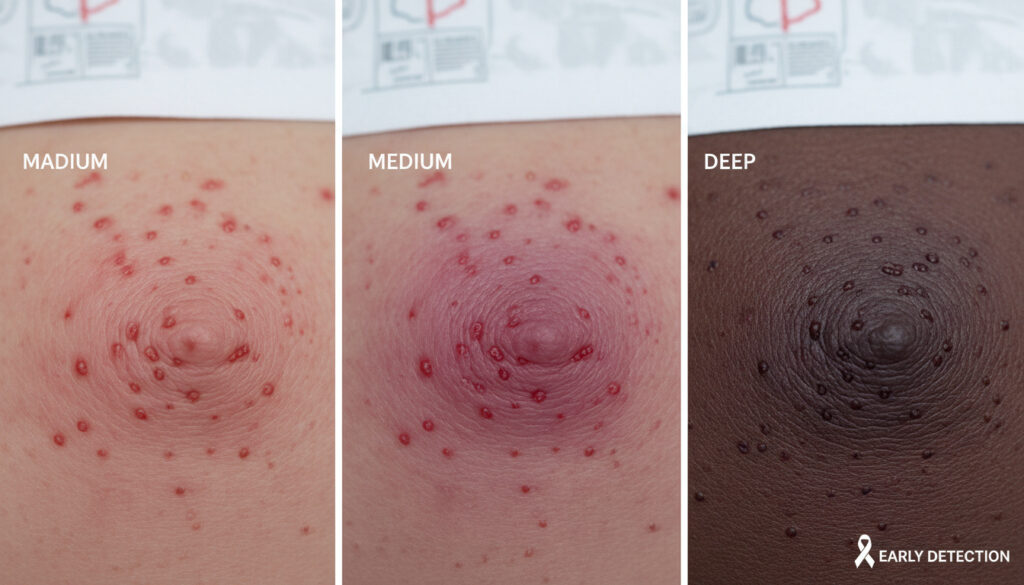
Pictures of Inflammatory Breast Cancer in Early Stages – Symptoms Across Skin Tones
Inflammatory breast cancer constitutes roughly 1 to 5 percent of all breast cancer diagnoses, yet it accounts for a disproportionate share of breast cancer mortality due to its aggressive nature and tendency to present without the telltale lump most people associate with the disease. Unlike other forms that form discrete masses, this cancer invades the lymphatic vessels of the skin, producing visual changes that mimic dermatological conditions or infections. The cancer progresses rapidly, often advancing within weeks rather than months, which means early visual recognition can significantly alter treatment trajectories.
Educational imagery of early-stage inflammatory breast cancer reveals patterns distinct from benign rashes. Medical documentation shows that nearly 70 percent of patients present with diffuse redness covering more than one-third of the breast, while approximately half experience acute swelling. These symptoms typically appear suddenly and intensify over time, distinguishing them from minor skin irritations that resolve spontaneously. Understanding these visual markers across diverse skin tones remains critical, as symptom presentation varies substantially based on melanin levels, and African American women face both higher incidence rates and younger median diagnosis ages compared to white women.
What Do Pictures of Inflammatory Breast Cancer in Early Stages Show?
Rash or Discoloration
Persistent color changes affecting more than one-third of the breast surface, appearing pink, red, purple, or bruised depending on skin tone. Unlike allergic reactions, these patches do not fade with time.
Rapid Swelling
Noticeable enlargement of one breast compared to the other, often accompanied by warmth and heaviness. The breast may increase in size dramatically within days or weeks.
Peau d’Orange
Skin dimpling resembling orange peel texture caused by lymphatic fluid accumulation. This hallmark feature indicates blocked lymphatic vessels beneath the skin surface.
Nipple Changes
Inversion, flattening, or dimpling of the nipple, sometimes accompanied by persistent itching or burning sensations localized to the areola.
- Rapid onset distinguishes inflammatory breast cancer from benign rashes, with symptoms escalating within days rather than weeks
- Visual presentation varies significantly by skin tone, requiring recognition of purple or dark discoloration on darker skin rather than classic bright redness
- Absence of a palpable lump is common in early stages, making skin changes the primary diagnostic indicator
- Rash typically affects more than one-third of the breast surface, differentiating it from localized skin conditions
- Symptoms worsen and expand rather than improve, with rashes progressing to cover significant breast portions within six months
- Early detection requires recognition of peau d’orange texture, which indicates lymphatic involvement
- Prompt medical evaluation significantly improves treatment outcomes for this aggressive cancer subtype
| Clinical Fact | Detail |
|---|---|
| Prevalence | 1–5% of all breast cancer diagnoses |
| Symptom Onset | Weeks rather than months |
| Stage at Diagnosis | Often Stage III or IV due to aggressive nature |
| Key Visual Marker | Diffuse redness covering >1/3 of breast |
| Redness Incidence | 69.8% of patients (Cancer Medicine study, n=701) |
| Swelling Incidence | 48.6% of patients (Cancer Medicine study) |
| Median Diagnosis Age (White women) | 58 years |
| Median Diagnosis Age (Black women) | 54 years |
| Typical Initial Symptom | Rash or skin texture changes, not palpable lump |
| Progression Timeline | Significant breast coverage within 6 months |
What Are the First Symptoms of Inflammatory Breast Cancer?
Patients and survivors describe the initial onset as deceptively benign. A slight color change or minor texture difference often appears suddenly, followed by rapid deterioration. According to the National Breast Cancer Foundation, symptoms develop within weeks and include persistent itching, pain, or burning sensations that do not respond to topical treatments.
Early Rash Characteristics
The earliest photographic documentation shows discoloration beginning in localized areas before expanding. Unlike bruising from trauma, these color changes intensify rather than resolve over time. Health Central notes that within six months, rashes progress from small patches to covering significant portions of the breast. The discoloration may appear pink or red on lighter skin tones, while darker skin tones may exhibit purple, dark brown, or bruised appearances.
Physical Sensations and Structural Changes
Tenderness and warmth accompany the visual changes, with the affected breast feeling noticeably heavier than its counterpart. The skin develops peau d’orange—extensive dimpling, rippling, or bumpy coarseness caused by lymphatic fluid accumulation. Medical News Today emphasizes that this texture change represents blocked lymph vessels and constitutes one of the classic skin presentations of inflammatory breast cancer.
Unlike normal rashes that fluctuate or improve, inflammatory breast cancer symptoms persist and worsen despite time or typical skin treatments. Unilateral presentation—symptoms affecting only one breast—strongly indicates malignancy rather than dermatological conditions.
Lymphatic Involvement
Early stages frequently include swollen lymph nodes near the collarbone or under the arm on the affected side. This lymphadenopathy indicates that the cancer has already engaged the lymphatic system, a defining characteristic of this cancer subtype. The Breast Cancer Research Foundation confirms that edema and swelling result from cancer cells blocking lymphatic vessels in the skin.
Pictures of Inflammatory Breast Cancer in Early Stages for Diverse Skin Tones
Visual recognition requires understanding how melanin affects symptom presentation. MD Anderson Cancer Center reports that on lighter skin tones, inflammatory breast cancer typically presents as bright redness accompanied by tenderness and warmth. However, this classic “redness” description fails patients with darker skin, where the same underlying pathology manifests as dark or purple discoloration.
Recognition Challenges on Darker Skin
The visual subtlety on darker skin tones contributes to delayed diagnosis. Rather than the dramatic erythema visible on lighter skin, patients may notice a deepening of natural skin color, bruise-like patches, or subtle textural changes without obvious color shift. The IBC Network highlights that African American women face both increased risk and younger onset, with a median diagnosis age of 54 compared to 58 in white women, making skin-tone-specific recognition crucial for early detection.
Cross-Population Consistency
Despite color variations, certain features remain consistent across ethnicities. Peau d’orange presents similarly regardless of skin tone, as the dimpling and skin thickening result from physical fluid accumulation rather than color change. Similarly, the rapid onset and unilateral presentation provide diagnostic clues that transcend skin color differences.
Ultrasound Images of Inflammatory Breast Cancer in Early Stages
While clinical photography documents surface changes, diagnostic imaging reveals the subdermal pathology. Ultrasound examinations typically show skin thickening greater than 2 millimeters and disrupted lymphatic channels. Unlike standard breast cancer, which often presents as a discrete mass on imaging, inflammatory breast cancer manifests as diffuse architectural distortion and increased echogenicity throughout the breast tissue.
Mammography frequently misses early-stage inflammatory breast cancer because the cancer lacks a defined tumor mass. Instead, images may show only trabecular thickening or skin changes, necessitating additional ultrasound or MRI evaluation for confirmation.
Biopsy remains the definitive diagnostic tool, as imaging alone cannot distinguish inflammatory breast cancer from mastitis or other inflammatory conditions. Medical experts emphasize that prompt determination of the underlying cause is essential, as early treatment significantly improves outcomes.
If surface changes suggest inflammatory breast cancer but initial imaging appears normal, request additional evaluation. One documented survivor case involved a patient who recognized peau d’orange on November 8th, insisted on expedited assessment when scheduling delays occurred, and received diagnosis by December 4th—demonstrating that persistence with healthcare providers can accelerate diagnosis.
How Quickly Does Inflammatory Breast Cancer Progress?
The timeline of inflammatory breast cancer distinguishes it from indolent breast cancers. Symptoms escalate dramatically within short timeframes, requiring immediate medical attention rather than watchful waiting.
- Week 1: Sudden onset of mild redness or discoloration, often mistaken for minor skin irritation or bug bite
- Weeks 2–4: Development of measurable swelling, breast enlargement, and emergence of peau d’orange texture
- Months 2–3: Rash expansion beyond initial boundaries, increased warmth, and potential nipple inversion
- Month 6: Significant portions of breast affected, with possible involvement of axillary or supraclavicular lymph nodes
- Beyond 6 months:Without treatment, progression to systemic symptoms and metastatic spread
The National Breast Cancer Foundation notes that unlike normal rashes that may come and go, inflammatory breast cancer symptoms become increasingly persistent as the cancer advances. The progression from initial symptoms to significant skin involvement can occur within weeks, underscoring the urgency of medical evaluation.
What Are the Established Signs Versus Uncertain Mimics?
Distinguishing inflammatory breast cancer from benign conditions presents significant diagnostic challenges, particularly in early stages when symptoms overlap with common infections or dermatological issues.
| Established Information | Uncertain or Requires Clarification |
|---|---|
| Unilateral presentation (single breast involvement) | Definitive differentiation from mastitis without biopsy |
| Rapid onset over days to weeks | Predicting which rashes will resolve versus progress |
| Diffuse redness or discoloration covering >1/3 of breast | Visual thresholds for diagnosis across all skin tones |
| Peau d’orange texture indicating lymphatic blockage | Early-stage detection rates without palpable lump |
| Lack of improvement over time | Specific timelines for symptom progression in every case |
| Absence of palpable lump in early stages | Why some patients present with mass while others do not |
Medical literature confirms that inflammatory breast cancer rarely produces a palpable breast lump, making it easily overlooked during conventional self-examination that focuses on detecting masses. This characteristic necessitates heightened awareness of skin changes as primary diagnostic indicators.
Understanding the Diagnostic Challenge
Inflammatory breast cancer blocks lymphatic vessels within the breast skin and underlying tissue, creating the distinctive visual symptoms that characterize the disease. This lymphatic invasion differentiates it from other breast cancers that primarily form tumors within milk ducts or lobules. The blockage causes fluid accumulation, resulting in the edema, warmth, and skin dimpling visible in early-stage documentation.
The aggressive nature of this cancer subtype means that by the time visual symptoms appear, the disease has often already reached advanced stages. Late diagnosis frequently occurs because the cancer lacks the typical presenting feature of a breast lump and can be mischaracterized as a dermatological problem or infection. MD Anderson Cancer Center survivor accounts consistently describe initial misdiagnosis as skin conditions or allergies before the rapid progression revealed the malignant nature of the symptoms.
Recognition across diverse populations remains particularly vital given the demographic variations in incidence and age at onset. For those monitoring other health concerns, resources such as How to Check for Prostate Cancer at Home – Symptoms and Home Tests demonstrate the broader importance of visual symptom recognition in cancer detection, though inflammatory breast cancer specifically requires professional clinical evaluation rather than home monitoring.
What Do Survivors and Medical Experts Report?
Firsthand accounts provide crucial context for understanding the lived experience of early-stage symptoms. These narratives emphasize the deceptive initial presentation and the importance of persistence when seeking medical care.
The rash didn’t fade. It wasn’t like a normal skin irritation that disappears with cream or time. It got deeper, spread wider, and the skin started looking like orange peel.
— Survivor account, MD Anderson Cancer Center
Extensive dimpling, rippling, or bumpy coarseness represents one of the classic skin changes. When lymphatic vessels block, the skin takes on this distinctive texture that doesn’t resolve with antibiotics or topical treatments.
— Breast imaging experts, Health Central
Medical authorities including the Breast Cancer Research Foundation and dermatological oncology specialists stress that any persistent rash, swelling, or dimpling affecting one breast—particularly symptoms that progress rather than resolve—warrants immediate medical evaluation. The convergence of survivor experience and clinical expertise points to rapid onset and unilateral presentation as the most reliable early indicators.
What Should You Do If You Notice These Signs?
Seek immediate medical evaluation if you observe sudden redness, swelling, or skin texture changes affecting one breast, particularly if these symptoms persist beyond one week or worsen despite time. Unlike self-monitoring approaches used for other conditions—such as selecting appropriate Incontinence Pants for Women – Best 2025 Picks and Guide for symptom management—inflammatory breast cancer requires urgent diagnostic imaging and biopsy confirmation. Early-stage diagnosis, though challenging due to the lack of palpable lumps, significantly expands treatment options and improves survival outcomes for this aggressive cancer.
Frequently Asked Questions
How is inflammatory breast cancer different from other breast cancers?
Unlike other breast cancers that form discrete lumps, inflammatory breast cancer invades lymphatic vessels, causing diffuse skin changes including redness, swelling, and peau d’orange texture. It progresses rapidly, often within weeks, and typically presents at stage III or IV due to aggressive lymphatic involvement.
Can mammograms detect inflammatory breast cancer in early stages?
Mammograms frequently miss early-stage inflammatory breast cancer because the cancer lacks a defined tumor mass. Imaging may show only skin thickening or trabecular changes, necessitating ultrasound or MRI and definitive biopsy for diagnosis.
Why does inflammatory breast cancer cause a rash?
The rash results from cancer cells blocking lymphatic vessels in the breast skin, causing fluid accumulation, inflammation, and redness or discoloration. This lymphatic blockage creates the characteristic peau d’orange appearance and warmth.
Is inflammatory breast cancer always painful?
Not necessarily. While many patients report itching, burning, or tenderness, others experience primarily visual changes without significant pain. The absence of pain does not rule out this cancer; any persistent unilateral skin changes require evaluation regardless of pain levels.
How fast does the rash spread?
The rash typically progresses from small patches to covering significant portions of the breast within six months. However, many patients report noticeable expansion within two to four weeks of initial appearance, distinguishing it from static benign rashes.
Can inflammatory breast cancer be mistaken for mastitis?
Yes, particularly in women who are breastfeeding or have recently given birth. Both conditions cause redness, swelling, and warmth. However, mastitis usually improves with antibiotics within days, while inflammatory breast cancer persists and worsens.
What should I do if I suspect I have inflammatory breast cancer?
Request immediate evaluation from a healthcare provider, specifically mentioning your concern about inflammatory breast cancer. If initial assessment is delayed or symptoms are dismissed, seek a second opinion promptly, as early treatment significantly impacts outcomes.
More related posts
 Rescue Dogs Near Me in Ireland: Dublin Adoption Guide
 Barclays Share Price UK – Live Price, Charts and Analysis
 Santander Online Business Banking: Login UK Guide & Features
 How to Get Rid of Headaches Fast: NHS & Mayo Clinic Tips
 Cast of Nobody Wants This: Full List, True Story, Season 2
 Senegal National Football Team Players: Squad, Stars & 2026
 Easter School Holidays 2025: Ireland Dates & Calendar
 What Is a Polygon? Definition and Identification Guide