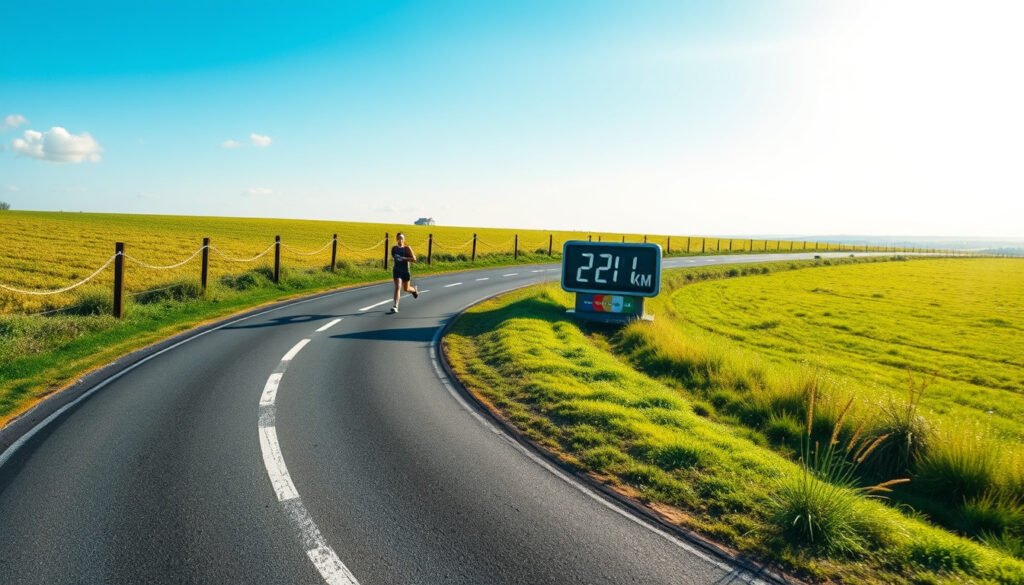
How Many Km is a Half Marathon? 21.1 km Guide + Times
If you’ve been building up your running with 5Ks and 10Ks, you’ve probably started wondering whether the next logical step is within reach. A half marathon sits right at that threshold — far enough to demand respect, short enough that most runners can get there with a solid plan. This guide covers the exact distance, what counts as a good finish time, and how to bridge the gap from your last 10K to race day.
Distance: 21.0975 km · Miles equivalent: 13.1 miles · Half of marathon: Yes · Training period: 3 months
Quick snapshot
- The official half marathon distance is exactly 21.0975 kilometres (World Athletics)
- That works out to 13.1094 miles, or precisely 13 miles and 192.5 yards (Marathon Handbook)
- It is exactly half the marathon distance of 42.195 km, which was standardised in 1921 (Finishers)
- Average finish times vary significantly by age group and gender; precise demographic breakdowns are limited in public data
- Injury rates differ between 12-week and 20-week training approaches, but comparative studies are sparse
- Marathon distance standardised at 42.195 km in 1921; half marathon follows from that figure
- Hal Higdon’s Novice 1 plan runs 12 weeks with 5K race in week 6 and 10K race in week 9
- Couch to Half Marathon plan spans a full 20 weeks for complete beginners
- Start with a 10K running ability, then build over 12–20 weeks with progressive long runs
- Key workouts include Saturday long runs building to 18–20 km and cross-training on easy days
- Race day tapers down mileage in the final two weeks before the start line
How many km is a half marathon?
A half marathon is exactly 21.0975 kilometres long — a figure set by halving the official marathon distance of 42.195 km. This standardisation traces back to 1921 when the marathon distance was locked in, and the half simply inherits half of that total. World Athletics (the international governing body for road running) confirms this distance for all official road racing events worldwide.
In miles, that works out to 13.1094 — most people round it to 13.1 miles, but if you want precision, it is exactly 13 miles and 192.5 yards. The distance holds consistently across every organised half marathon on the planet, from major city events to small local races. There are no regional variations: every runner lining up at the start knows exactly what 21.0975 km feels like.
You will cover roughly 20,000 to 22,000 steps over the course of a half marathon, according to Marathon Handbook (running distance resource). That gives you a useful reference point if you track steps on a wearable device — it is a mental benchmark that makes 21 km feel more concrete.
These verified figures and authoritative sources give you the concrete numbers behind the half marathon distance:
| Measurement | Value | Source |
|---|---|---|
| Official distance | 21.0975 km | World Athletics |
| US miles | 13.1094 miles | Marathon Handbook |
| Marathon half | 42.195 km ÷ 2 | Finishers |
| Typical beginner time | 2–2.5 hours | Runner’s World |
| Average all runners | 01:50:15 | Running Level |
| World record | 58:01 | Running Level |
The half marathon sits comfortably between the 10K and the full marathon — close enough that many runners use it as a stepping stone before committing to 42.195 km on race day. Half marathons are frequently held alongside full marathons, using the same course for the first half before turning back.
What is a good half marathon time?
What counts as a good time depends entirely on your experience level. For first-time half marathon runners, Runner’s World (running publication with training expertise) suggests finishing under 3 hours is a realistic and respectable target. That translates to roughly a 8:31 minute-per-kilometre pace — manageable for most runners who have built a base through regular training.
For experienced runners who already have a running foundation, under 2 hours is a common benchmark. That requires averaging about a 5:41 minute-per-kilometre pace throughout the race — a significant step up from the beginner level. The average across all runners, regardless of age or gender, sits around 01:50:15, according to Running Level (aggregated race time database). Male runners on average complete the distance in 01:43:33.
Beginner times
If you are new to distances beyond the 10K, aim for a finish anywhere between 2 and 2.5 hours. This pace gives you room to navigate aid stations, adjust your stride on descents, and hold back slightly in the early kilometres before opening up in the second half. Most beginner training plans are built around achieving this window comfortably, not pushing runners to their limit on race day.
Average finish times
The 01:50:15 average covers a wide spread — it includes elites who finish in under an hour alongside first-timers crossing the line in nearly three hours. What that average tells you is that if you finish somewhere between 1:45 and 2:00, you are performing ahead of typical benchmarks. Most recreational runners fall in the 1:50 to 2:15 range.
Elite benchmarks
The fastest half marathon ever recorded stands at 58:01 — a pace that would see most people complete a 5K warm-up before an amateur runner finishes their first mile. Elite times are useful as context, not targets: they show what is physiologically possible, but the relevant benchmark for your first half is simply crossing the finish line feeling strong.
Setting a time goal before you have a training block behind you is backwards. Runner’s World training experts advise focusing on finishing your first race rather than obsessing over a specific time. A strong finish in 2:45 beats a blown pace at 2:05 that leaves you walking the final kilometres.
Can I run a half marathon if I can run 10K?
Yes — with the right build-up. If you can comfortably complete a 10K without stopping, you have the aerobic base to train for a half marathon. The distance difference is roughly a 110% increase (10 km to 21.1 km), which sounds significant but most training plans handle the progression gradually over 12 to 20 weeks.
The key is not the distance itself but the long run. Once you can handle a 10K, the next milestone is building your weekend long run up to 18–20 km during training. That single workout — the long Saturday run — is what prepares your body and mind for race day endurance.
Progression requirements
- Comfortable 10K completion as a baseline before starting a half marathon plan
- Long runs building incrementally from your current maximum
- At least one rest day per week — more if you are new to distance running
- Cross-training such as swimming or cycling on easy days to build fitness without impact stress
Training gap from 10K
The jump from 10K to half marathon is primarily mental as much as physical. Your body can handle the distance with gradual build-up, but going from running three or four times a week to covering 21 km on a weekend requires a structured plan. Most runners underestimate how much the taper and race-day nutrition matters — not just the training itself.
How to train for a half marathon
Two widely used beginner plans illustrate the range of approaches. Hal Higdon’s Novice 1 (12-week programme by running coach and author) expects you to already run 3–4 times weekly and builds long runs from 3 miles up to 10 miles before race day. Cross-training is encouraged on easy days, and the plan includes 5K and 10K race tune-ups in weeks 6 and 9 to build race-day experience.
At the other end, Outside Online’s Couch to Half Marathon (20-week programme for complete beginners) uses run-walk intervals from the start. This approach suits people who have not run regularly before — the 20 weeks give the body more time to adapt to impact loading, and walking breaks reduce fatigue in early weeks.
Beginner 3-month plan
Most standard half marathon training spans 12 weeks for runners with a 10K base, or 20 weeks if you are starting from a non-running background. The minimum recommended time is 12 weeks — pushing shorter than that significantly increases injury risk, according to Outside Online (outdoor fitness publication).
Weekly mileage build
- Week 1–4: Establish routine with 3–4 runs per week; long run builds to 8–10 km
- Week 5–8: Long runs climb to 14–16 km; mid-week runs increase in distance
- Week 9–11: Long runs reach 18–20 km; incorporate race-pace kilometres
- Week 12: Taper — reduce mileage by 30–40% to arrive fresh at the start line
Key workouts
Three workout types drive half marathon fitness: the long Saturday run (which builds endurance and mental toughness), a mid-week tempo or pace run (which sharpens your sustained speed), and easy recovery runs (which promote adaptation without excessive fatigue). Every plan should include a warm-up walk of 5 minutes before you start running and a cool-down walk after finishing — skipping either increases strain on your muscles and cardiovascular system.
If a particular week feels too hard, repeat it rather than pushing through. Outside Online’s programme guidance specifically advises against adding new strength training if you are new to weights during half marathon prep — the combined impact load from running plus lifting is a common injury trigger for beginners.
How long does a half marathon take?
Finish time comes down to pace. At an 6:00 min/km pace — a common target for recreational runners — you would complete a half marathon in approximately 02:06:27. Slow that to 7:00 min/km and you are looking at 02:27:41. Slow to 8:00 min/km and the clock shows 02:48:55. The numbers are straightforward: pace multiplied by 21.0975 km equals your finish time. If you’re looking for more information on half marathon preparation, you can find it here найкраще спорядження для кемпінгу.
For most beginners, the realistic window is 1.5 to 2.5 hours. Experienced runners targeting a sub-2:00 finish need to hold roughly 5:41 min/km throughout the race. Elite runners complete the distance in under an hour — the world record of 58:01 averages out to a jaw-dropping 2:45 min/km.
Average times by pace
These pace-to-finish-time calculations show how your target pace translates directly to your overall half marathon time:
- 5:00 min/km pace → finish time approximately 01:45:29
- 5:30 min/km pace → finish time approximately 01:56:02
- 6:00 min/km pace → finish time approximately 02:06:27
- 6:30 min/km pace → finish time approximately 02:16:52
- 7:00 min/km pace → finish time approximately 02:27:41
- 8:00 min/km pace → finish time approximately 02:48:55
Factors affecting duration
Several variables stretch or compress your finish time beyond raw pace. Weather matters significantly — heat and humidity add minutes; a cool, dry day can shave time. Course terrain is a major factor: a flat city loop yields faster times than a hilly trail route. Aid station logistics also play a role — if you need water or energy at every station, you lose a few seconds per stop. Finally, your training matters: a runner who has done multiple long runs at race pace will hold that pace better than one who trained at a slower or inconsistent intensity.
The implication: two runners with identical average paces can finish minutes apart based on conditions and course profile alone. This is why experienced runners talk about course reconnaissance and weather planning in the days before a race.
Your first half marathon: a practical checklist
Moving from a 10K base to race-ready is a matter of structured progression. Here is what the build looks like in practice:
Upsides
- 21.0975 km is a standardised, globally recognised distance — no ambiguity about what you are training for
- 12 weeks of consistent training is enough for most runners with a 10K base
- Cross-training and rest days are built into every reputable plan, reducing injury risk
- Finishing a half marathon builds both physiological endurance and race-day confidence for longer events
- World record sits at 58:01 — you can set any reasonable time goal knowing exactly what benchmark you are chasing
Downsides
- Underestimating the long run and skipping progressive mileage build leads to hitting the wall around kilometre 16–18
- Trying to compress training into under 12 weeks is a leading cause of half marathon injuries
- No strength training experience plus a new running plan creates compounded injury risk
- Beginners often start too fast — the first 5 km of a half marathon should feel deliberately easy
If you’re preparing for your debut half marathon, we advise concentrating on a pace that will allow you to finish.
— Runner’s World (running publication with training expertise)
Rest is as important a part of your training as the runs.
The half marathon distance of 21.0975 km is not going anywhere — it is locked in by World Athletics (international governing body for road running) as a permanent standard. What changes is your readiness to cover it. If you have a 10K in your legs and 12 to 20 weeks of progressive training ahead, the finish line is realistic. The runner who hesitates is usually not uncertain about the distance — they are uncertain about whether they have enough time. Most people do.
Related reading: half marathon distance origins
The standard half marathon spans 21.0975 km, which converts to 13.1 miles exactly for runners accustomed to imperial measurements worldwide.
Frequently asked questions
How many steps is a half marathon?
Most runners cover approximately 20,000 to 22,000 steps during a half marathon, according to Marathon Handbook (running distance resource). World Athletics estimates closer to 26,200 steps — the variation depends on stride length, which differs between runners and between walking and running segments of a race.
How many km is a marathon?
A full marathon is 42.195 km — exactly twice the half marathon distance. This figure was standardised in 1921 and has remained fixed ever since. The half marathon’s 21.0975 km is precisely half of that official marathon distance.
Is 2 hours a good half marathon time?
Yes — 2 hours (or just under) is a solid target for runners with a consistent training background. That pace averages about 5:41 min/km, which puts you ahead of the overall average of 01:50:15 and well within the beginner-friendly finish window.
Is running 21km in 2 hours good?
Running 21.0975 km in exactly 2 hours requires a pace of 5:41 min/km — a strong intermediate performance. Runner’s World sets under 2 hours as a good target for experienced runners, making a sub-2:00 finish a credible achievement for anyone who has trained consistently for 12 weeks or more.
What is the 80/20 rule in running?
The 80/20 rule in running means roughly 80% of your training volume at an easy pace and 20% at a harder effort. This distribution is backed by exercise physiology research — easy runs build aerobic capacity and recovery efficiency while the harder sessions develop speed and lactate threshold. Most half marathon training plans naturally lean this way without requiring explicit calculation.
How do I progress from running 10Ks to a half marathon?
Start a structured half marathon plan with a comfortable 10K as your baseline. Follow the long-run progression carefully, building from your current maximum to 18–20 km over 8–10 weeks. Include cross-training on easy days and never skip rest days. If a week feels too hard, repeat it rather than advancing — consistency over 12 to 20 weeks matters more than rushing the progression.
How many km is a half marathon for beginners?
For beginners, the half marathon is exactly 21.0975 km — the same official distance as for every other runner. The difference is not the distance but the training background: beginners typically follow a 20-week plan from a non-running starting point, while more experienced runners can use a 12-week plan built on an existing running base.
More related posts
 Star Wars Skeleton Crew: Worth Watching? Episodes & Age Rating
 Virgin Customer Service Number: Ireland, UK & Contacts
 Plymouth Argyle vs Sheffield United – Final Score and Key Insights
 Jennifer Aniston Net Worth – $320 Million Breakdown 2024
 Rhodes Earthquake Today: Latest Updates and Safety Advice
 British Airways Discount Code – Verified Savings 2026
 When Does Gen Z Start – Official Birth Years Explained
 BT Wholesale Speed Test Retired: What Happened & Alternatives