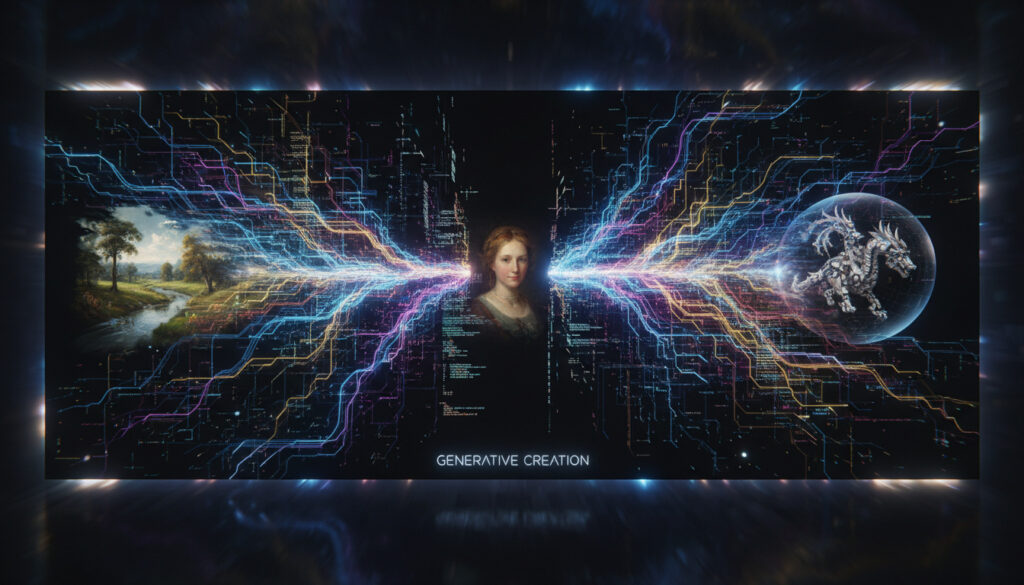
What Is Generative AI – Definition, Examples, Uses
Generative artificial intelligence has shifted from research laboratories to mainstream applications, producing text, images, and code that often match human quality. This technology represents a fundamental departure from conventional computing, using deep learning to create rather than merely process information.
At its core, generative AI refers to machine learning systems that generate original content—ranging from written articles to musical compositions—by identifying patterns in vast training datasets. IBM Research defines it as a subfield that creates novel outputs in response to natural language prompts, distinguishing it from systems designed solely for classification or analysis.
The implications extend across industries, from healthcare diagnostics to software development, prompting organizations like Microsoft and Amazon Web Services to integrate these capabilities into enterprise platforms.
What is Generative AI and How Does It Work?
AI systems that generate novel content by learning patterns from training data
GPT series, DALL-E, Stable Diffusion
Deep learning neural networks and transformers
Multimodal integration across text, image, and audio
- Generates original content rather than analyzing existing data
- Operates through neural networks inspired by human brain structures
- Requires massive datasets for training—often terabytes of unlabeled information
- Uses tokenization to process natural language inputs
- Refines outputs through reinforcement learning from human feedback
- Outputs can be indistinguishable from human-created content
- Differs fundamentally from traditional predictive AI systems
| Aspect | Details |
|---|---|
| Primary Function | Creates new text, images, videos, audio, or code from learned patterns |
| Training Method | Unsupervised or supervised learning on massive datasets |
| Key Architectures | GANs, Diffusion Models, VAEs, Transformers |
| Input Processing | Tokenization of prompts into processable units |
| Output Characteristics | Probabilistic, novel, contextually relevant generation |
| Enterprise Platform | IBM watsonx for business deployment |
| Notable Launch | ChatGPT, November 2022 |
| Technical Foundation | Deep learning with backpropagation error correction |
The operational mechanics involve three distinct phases. During training, models ingest massive unlabeled datasets using unsupervised learning techniques, predicting next elements in sequences through exercises analogous to fill-in-the-blank tasks. MIT News explains that this process relies on backpropagation to minimize prediction errors iteratively.
Fine-tuning follows, adapting foundation models for specific applications through reinforcement learning from human feedback. Finally, during generation, user prompts undergo tokenization—breaking input into words or subwords—before the system predicts and assembles outputs, with iterative evaluation ensuring quality.
What Are Generative AI Examples?
Contemporary applications demonstrate remarkable versatility across media types. Large language models like ChatGPT generate human-like text for chatbots, content summarization, and code snippet production. Coursera identifies DALL-E as a prominent text-to-image model capable of creating artwork and designs from textual descriptions.
Is ChatGPT Generative AI?
Yes. ChatGPT operates on the GPT (Generative Pre-trained Transformer) architecture, qualifying it as a definitive example of generative AI. The system generates coherent text responses by predicting subsequent words based on prompt context and training data patterns. This capability extends beyond simple response generation to include creative writing, technical documentation, and programming assistance.
Additional examples include Stable Diffusion, an open-source image generator utilizing diffusion architecture, and MuseNet, which composes musical pieces and audio content. These tools demonstrate how the same underlying principles apply across different content modalities.
Systems that create new outputs from scratch—such as drafting emails, painting digital artworks, or composing music—represent generative AI. Tools that only sort, classify, or recommend existing content do not fall under this category.
What is Generative AI vs AI?
The distinction between generative AI and traditional artificial intelligence centers on output type and operational purpose. While generative systems create original content, conventional AI focuses on analysis, classification, and prediction of existing data.
Understanding the Distinction
Traditional AI applications include image classifiers that identify objects within photographs and recommendation systems that suggest products based on historical behavior. These systems interpret and categorize existing information rather than producing novel material. Wikipedia notes that generative models instead learn to capture the statistical structure of training data to generate new samples with similar characteristics.
Agentic AI vs Generative AI
Agentic AI represents an emerging evolution that builds upon generative foundations while adding autonomous agency. Where generative AI produces content in response to prompts, agentic systems plan, reason, and execute tasks independently across multiple steps. Generative models provide the reasoning engine for agentic applications, but the latter extends capabilities toward goal-directed actions rather than single-output generation.
According to MIT research, the boundaries between generative and traditional AI increasingly blur as identical algorithms serve both creative generation and predictive classification tasks depending on configuration and training methodology.
What is Generative AI Used For?
Enterprise and consumer applications span content creation, software development, and scientific research. Organizations deploy these tools for drafting marketing materials, generating code documentation, and producing voiceovers for multimedia projects.
What is Generative AI in Healthcare?
Medical applications leverage generative capabilities for synthetic data generation, enabling researchers to simulate patient populations without compromising privacy. Drug discovery processes benefit from molecular structure generation, while medical imaging augmentation assists diagnostic training. Oracle documents how these applications rely on the same deep learning architectures powering consumer tools, adapted for biomedical datasets.
IBM’s watsonx platform exemplifies enterprise deployment, offering foundation models specifically tuned for healthcare analytics and business applications. The platform integrates training, tuning, and generation phases into secure enterprise environments.
Healthcare applications require rigorous verification. While generative AI can augment imaging and research, medical professionals must validate all AI-generated diagnostic suggestions or treatment recommendations against established clinical standards.
How Has Generative AI Developed Over Time?
- — Ian Goodfellow introduces Generative Adversarial Networks (GANs), pioneering adversarial training methodologies that enable realistic image generation through competition between generator and discriminator networks.
- — Variational Autoencoders (VAEs) advance image generation capabilities while transformer architectures begin enabling sophisticated language models.
- — OpenAI releases GPT-3, demonstrating unprecedented scale in language model capabilities and training data volume.
- — DALL-E emerges, applying generative principles to visual content creation from textual descriptions.
- — Stability AI releases Stable Diffusion as open-source software, while OpenAI launches ChatGPT in November, catalyzing mainstream adoption.
- — Enterprise integration accelerates with platforms like IBM watsonx and AWS generative AI services entering widespread commercial deployment.
What Do We Know for Certain About Generative AI?
Established Facts
- Systems generate probabilistic outputs based on training data patterns
- Neural network architectures require substantial computational resources
- Reinforcement learning from human feedback improves output quality
- Content generation extends across text, image, audio, and code modalities
- Training involves unsupervised learning on unlabeled datasets
Ongoing Uncertainties
- Long-term regulatory frameworks remain under development
- Ethical boundaries for autonomous content generation lack consensus
- Intellectual property implications of training data usage await legal clarification
- Environmental impact of large-scale model training requires further study
- Timeline for achieving artificial general intelligence through generative methods remains speculative
Where Did Generative AI Originate?
The conceptual roots trace to early neural network research predating 2010, but practical implementation required advances in computational power and data availability. The 2014 introduction of GANs marked a pivotal moment, establishing a framework where two neural networks compete—one generating content, the other discriminating between real and artificial outputs—until results achieve high fidelity.
Subsequent developments in diffusion models and transformer architectures expanded capabilities beyond images into language and multimodal applications. The technology now sits at the intersection of cognitive science research and large-scale cloud computing infrastructure.
What Do Authority Sources Say?
Generative AI uses deep-learning models to create original content such as text, images, videos, audio, or code in response to user prompts.
— IBM Think Topics
These models learn the patterns and structure of their input training data, then generate new data that has similar characteristics.
— Wikipedia, Generative Artificial Intelligence
What Defines Generative AI in 2025?
Generative AI encompasses machine learning systems that create original, contextually relevant content across multiple modalities by recognizing patterns in training data. Unlike analytical AI, these tools produce rather than merely process information, finding applications from What Is Generative AI – Definition, Examples and How It Works to enterprise healthcare platforms. As the technology evolves, distinctions between generative, traditional, and agentic AI continue to shift, requiring ongoing evaluation of capabilities and limitations.
Frequently Asked Questions
What is generative AI IBM?
IBM defines generative AI as deep-learning models that create original content and offers the watsonx platform for enterprise deployment, providing foundation models for business and healthcare analytics.
What is Generative AI course?
Coursera and major technology providers offer courses covering generative AI fundamentals, including IBM’s Think Topics, Microsoft’s AI-101, and MIT’s technical explainers on neural network mechanics.
What is Generative AI in Healthcare?
Healthcare applications include synthetic data generation for research, drug discovery simulations, and medical imaging augmentation, though all outputs require professional medical validation.
Is ChatGPT generative AI?
Yes, ChatGPT operates on GPT architecture, generating human-like text by predicting word sequences based on prompt context and training data patterns.
What is generative AI vs AI?
Generative AI creates original content like text and images, while traditional AI analyzes, classifies, or predicts based on existing data without generating novel outputs.
Agentic ai vs generative ai?
Agentic AI builds on generative capabilities but adds autonomous planning and reasoning to execute multi-step tasks, whereas generative AI focuses on creating content in response to specific prompts.
What is generative AI used for?
Applications span content creation, software development, design, and scientific research, including tools like What Is Generative AI – Definition, Examples, Tools for creative and enterprise purposes.
More related posts
 Devil Wears Prada: Sequel, True Story, Quotes & Cast
 Good American Family: Natalia Grace True Story & Age Dispute
 Eddie Howe: Illness, Salary, Coaching Career & Family Facts
 What Happens When You Die – Biological Stages and Timelines
 Jules Hudson: Biography, TV Career, Wife, Net Worth & News
 Harry and Meghan Latest – Queen’s ‘Unwise’ Oprah Remark Resurfaces
 When Does Gen Z Start – Official Birth Years Explained
 Big Night of Musicals 2026: Songs, Tickets & BBC One Guide