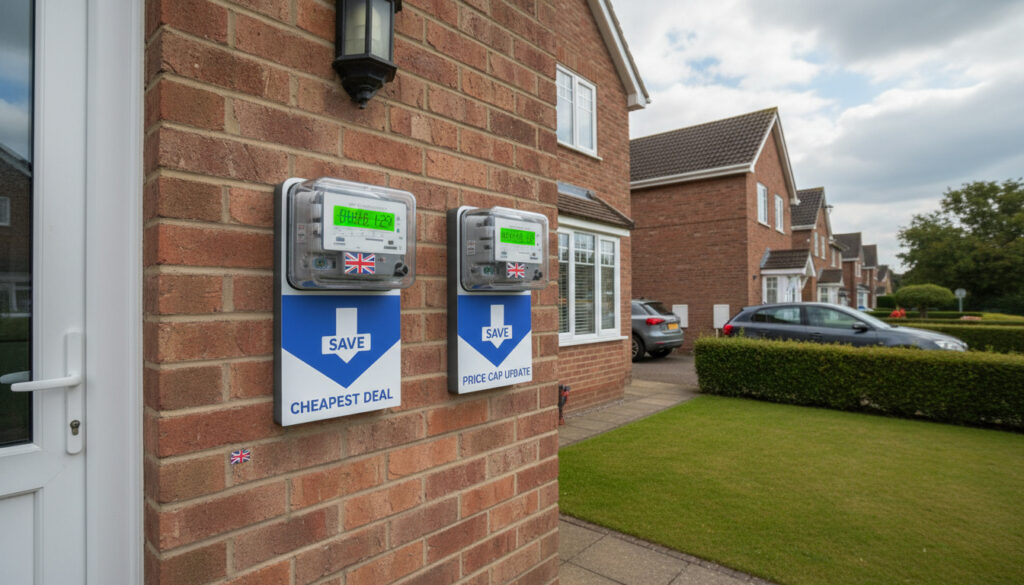
Gas and Electric Prices – Cheapest UK Deals and Cap Update
Household energy costs have shifted dramatically following the April 2026 price cap adjustment, with typical annual bills falling to £1,641 before forecasters predict a steep summer climb. The 6.7% reduction reflects temporary government interventions, yet major suppliers anticipate a 17% surge from July that could push average payments toward £1,925.
For millions of households navigating standard variable tariffs, understanding the mechanics of price comparison has become essential. While the current cap offers brief respite, fixed-rate deals and tracker options present alternative pathways that consumer experts argue warrant immediate attention.
This analysis examines the available tariff structures, expert recommendations, and projected market movements to clarify where consumer leverage currently exists.
How to Compare Gas and Electricity Prices in the UK
Current Price Cap Level
£1,641/year for typical dual-fuel households paying by Direct Debit, effective April through June 2026.
Cheapest Fixed Deals
E.on Next Pledge and Outfox Energy Tracker currently offer the most competitive alternatives to standard variable rates.
Avg Savings Potential
Approximately £200 annually for households switching from the price cap to the cheapest available fixed tariffs.
Top Suppliers Ranked
E.on Next, Sainsbury’s Energy, and Outfox dominate the current fixed-rate market based on unit rate pricing.
- Cap Coverage: The Energy Price Cap currently applies to approximately 65% of homes across England, Scotland, and Wales.
- Temporary Relief: April 2026 brought a 6.7% decrease largely driven by the Government’s Autumn Budget announcement cutting household energy bills by £150 annually.
- Impending Surge: Forecasts indicate a 17% price cap increase from July 2026, followed by additional rises through January 2027.
- Rate Reductions: Electricity unit rates fell 3.37p/kWh and gas by 0.31p/kWh on April 1, 2026.
- Expert Consensus: Martin Lewis calculates £200 annual savings potential for consumers willing to switch from standard variable tariffs.
- Fixed Premiums: Current fixed deals range from 4.4% to 6.6% above the current price cap level.
- Exit Penalties: Early termination fees vary significantly between suppliers, ranging from £25 to £75 per fuel.
| Metric | Value | Period/Source |
|---|---|---|
| Standard Variable Cap | £1,641/year | April-June 2026 |
| Electricity Unit Rate Change | -3.37p/kWh (-3.54p inc VAT) | From April 1, 2026 |
| Gas Unit Rate Change | -0.31p/kWh (-0.33p inc VAT) | From April 1, 2026 |
| July 2026 Forecast | £1,925/year (Up 17%) | July-Sept 2026 |
| October 2026 Forecast | £2,007/year (Up 4%) | Oct-Dec 2026 |
| January 2027 Forecast | £2,018/year (Up 0.5%) | Jan-Mar 2027 |
| E.on Next Fixed 15m Premium | +4.4% vs price cap | 15-month term |
| Sainsbury’s Fix and Save 15m Premium | +6.6% vs price cap | 15-month term |
| Outfox Energy Tracker Discount | 5% off unit rates | Tracker tariff |
| E.on Next Pledge Discount | £100 off unit rates (avg) | Pledge tariff |
What Are the Cheapest Gas and Electric Deals Right Now?
Fixed-rate options currently available show mixed value compared to the prevailing price cap, with most requiring consumers to pay a premium now in exchange for protection against predicted summer increases. MoneySavingExpert analysis indicates that while immediate costs may rise slightly, the mathematical case for fixing strengthens considerably when weighed against the forecast 17% cap jump.
Fixed-Term Options
E.on Next offers the Next Fixed 15m tariff, which runs 4.4% more expensive than the current price cap. Sainsbury’s Energy provides the Fix and Save 15m product at 6.6% above cap levels. Both products lock unit rates for fifteen months, shielding households from the volatility expected through 2026 and into 2027.
Tracker and Discounted Alternatives
The E.on Next Pledge tariff offers £100 off average unit rates but attaches £25 per fuel in exit fees. Outfox Energy Tracker provides a 5% discount on unit rates relative to the cap, though it carries substantially higher early termination penalties of £75 per fuel. These options suit households confident in their ability to monitor market movements.
Fixed and tracker tariffs impose charges for premature switching. E.on Next Pledge levies £25 per fuel, while Outfox Energy Tracker charges £75 per fuel. These fees apply if you terminate the contract before the agreed term concludes, potentially eroding savings if circumstances change.
Martin Lewis Recommendations for Gas and Electric Prices
Consumer champion Martin Lewis emphasizes that while the price cap determines baseline rates for standard variable customers, active switching remains the primary mechanism for cost reduction. Recent guidance stresses that the cap functions merely as a maximum allowable charge, not an optimal target for household budgeting.
Should You Fix Now?
Lewis calculates that switching to the cheapest available fixes could save approximately £200 a year compared to remaining on the price cap, particularly as rates are expected to rise from July. His analysis suggests that households should compare potential savings against the predicted 17% price cap increase when evaluating fixed offers.
Strategic Timing
With forecasts indicating successive price cap rises through October 2026 and into 2027, Lewis argues that current fixed deals—despite appearing marginally expensive today—likely represent sound financial hedging. The calculation favors fixing for those who value budget certainty over the next eighteen months.
What is the Current Gas and Electricity Price Cap?
The Energy Price Cap sets the maximum amount suppliers can charge per unit of energy for households on standard variable tariffs. From April 1 to June 30, 2026, this cap stands at £1,641 annually for typical usage paid by Direct Debit, reflecting a 6.7% decrease from the previous quarter.
The April 2026 price cap reduction incorporates a £150 annual bill cut announced in the Government’s Autumn Budget. This policy intervention directly reduced baseline costs for standard variable tariff households, masking underlying wholesale market pressures.
Approximately 65% of homes across England, Scotland, and Wales remain on standard variable tariffs subject to Ofgem’s price cap regulation. The remaining households have opted for fixed-rate products or specialized time-of-use tariffs.
Unit Rate Specifications
Effective April 1, 2026, electricity unit rates decreased by 3.37p/kWh (3.54p including VAT), while gas unit rates fell by 0.31p/kWh (0.33p including VAT). These reductions apply to the per-kilowatt-hour charges before standing charges are applied.
Will Energy Prices Go Down? UK Forecast
Predictions from major energy suppliers including EDF, British Gas, and E.on Next indicate substantial price increases ahead, contradicting any expectation of sustained low prices.
- : Price cap falls 6.7% to £1,641/year, driven by government budget interventions.
- : Predicted 17% increase pushes typical bills to £1,925/year as wholesale costs rebound.
- : Further 4% rise anticipated, bringing average annual costs to £2,007.
- : Modest 0.5% increase projected to reach £2,018/year, suggesting plateauing rather than reduction.
What is Certain About Future Energy Costs?
Distinguishing between established regulatory facts and market projections helps households avoid decision paralysis.
Established Facts
- Current cap fixed at £1,641 through June 30, 2026
- Unit rate reductions of 3.37p/kWh (electricity) and 0.31p/kWh (gas) effective April 1
- £150 annual government contribution active
- E.on Next and Sainsbury’s fixed deal pricing verified
- Exit fee structures: £25 (E.on Pledge) and £75 (Outfox)
Uncertain Projections
- Exact price cap levels beyond predictions
- Long-term stability after January 2027
- Comparative positioning against European markets
- Detailed British Gas tariff structures beyond cap forecasts
- Wholesale market volatility impacts
How Do UK Gas and Electric Prices Fit Into the Broader Market?
Domestic energy pricing operates within a complex regulatory framework that isolates consumer bills from immediate wholesale fluctuations while maintaining supplier viability. The current Barclays Share Price UK – Live Price, Charts and Analysis reflects broader economic pressures that indirectly influence energy market liquidity and investment in generation infrastructure.
Comparative data regarding UK energy prices versus European markets remains unavailable in current research, preventing definitive statements about international positioning. Focus remains on the domestic regulatory environment and supplier competition within the Ofgem price cap framework.
Expert Analysis on Energy Pricing
Martin Lewis emphasizes that while the price cap determines baseline rates, consumers can achieve significant savings by switching to fixed tariffs or tracker deals.
MoneySavingExpert, 2026
Switching to the cheapest available fixes could save approximately £200 a year compared to remaining on the price cap, particularly as rates are expected to rise from July.
Consumer Finance Analysis
Key Takeaways on Gas and Electric Prices
The April 2026 price cap reduction offers temporary relief at £1,641 annually, yet forecasted increases of 17% from July necessitate immediate action for cost-conscious households. Fixed tariffs currently available—despite modest premiums—present viable hedging opportunities against rising costs, with Martin Lewis identifying £200 annual savings potential for proactive switchers. For those seeking related cost management strategies, consult our Gas Station Near Me – Cheapest Open Stations UK Guide.
Frequently Asked Questions
Are UK electricity prices the highest in the world?
Current research does not contain comparative data on UK energy prices versus Europe or global markets, so this cannot be definitively established.
What is the current gas and electricity price cap?
The price cap stands at £1,641 annually for typical dual-fuel households paying by Direct Debit, effective April 1 through June 30, 2026.
Should I fix my energy prices now?
Martin Lewis recommends comparing fixes against the predicted 17% July price cap increase. Current fixed deals may save approximately £200 annually despite appearing slightly above current cap levels.
How much have unit rates changed in April 2026?
Electricity unit rates decreased by 3.37p/kWh and gas by 0.31p/kWh from April 1, 2026, reflecting the Autumn Budget interventions.
What are the cheapest fixed deals available?
E.on Next Pledge offers £100 off average unit rates with £25 exit fees, while Outfox Energy Tracker provides 5% discounts with £75 exit fees. E.on Next Fixed 15m runs 4.4% above the cap.
How much can I save by switching?
Switching from the standard variable cap to the cheapest fixed tariffs could reduce annual bills by approximately £200, according to MoneySavingExpert calculations.
More related posts
 Car Valet Near Me: Costs, Benefits, and What’s Included
 We Live in Time Reviews: Worth Watching or Tearjerker?
 Seven Seas Joint Care: Benefits, Side Effects & Best Variants
 Sarah J Maas Books in Order: Guide to ACOTAR, Throne of Glass
 Cast of Two Pints of Lager and a Packet of Crisps – Actors Roles Changes
 When Is the First Day of Spring? Dates for 2026 & Beyond
 TV Shows with Millie Gibson: Full Filmography & Career Guide
 How to Cure Rheumatoid Arthritis Permanently: Remission Guide